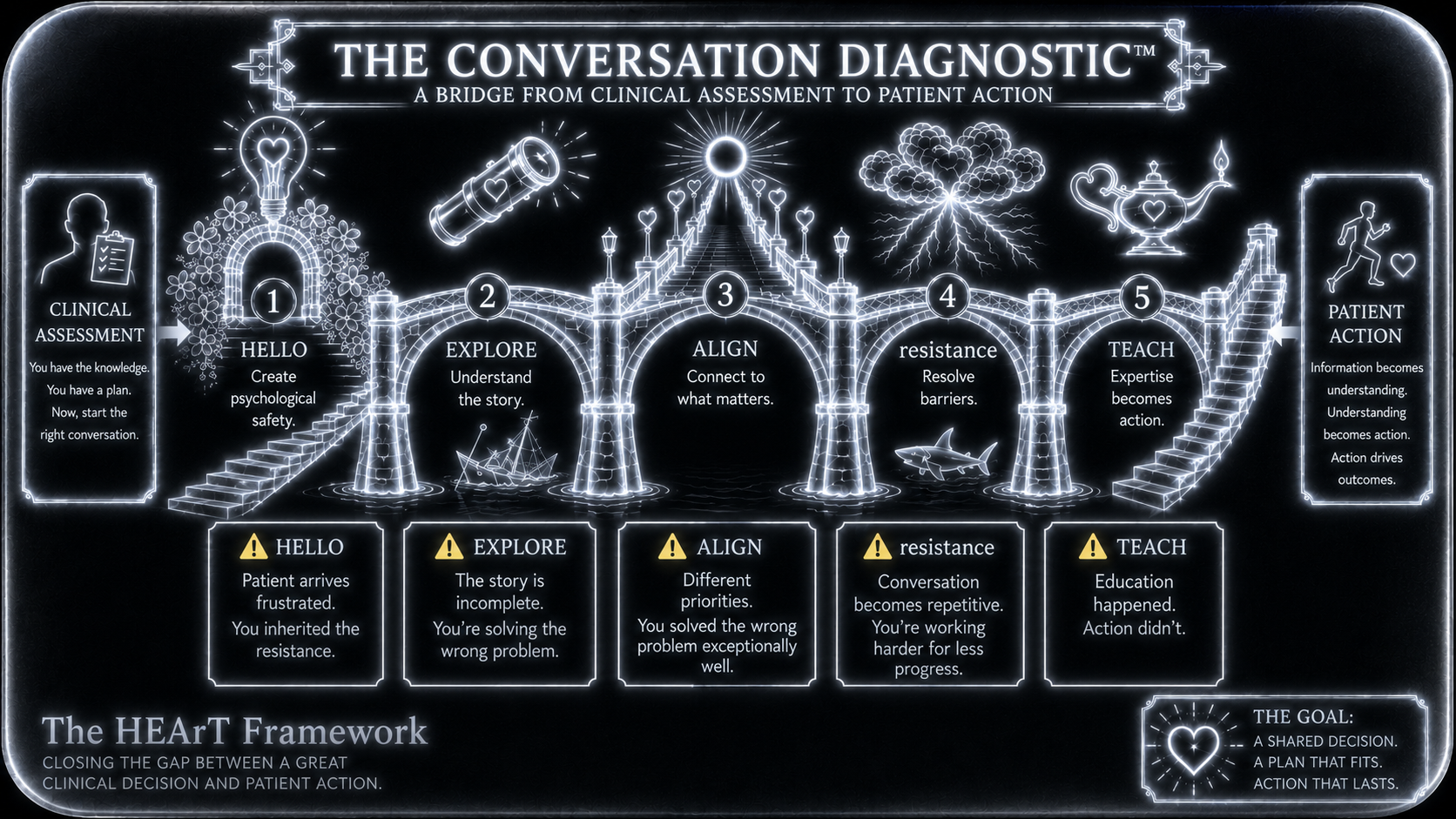
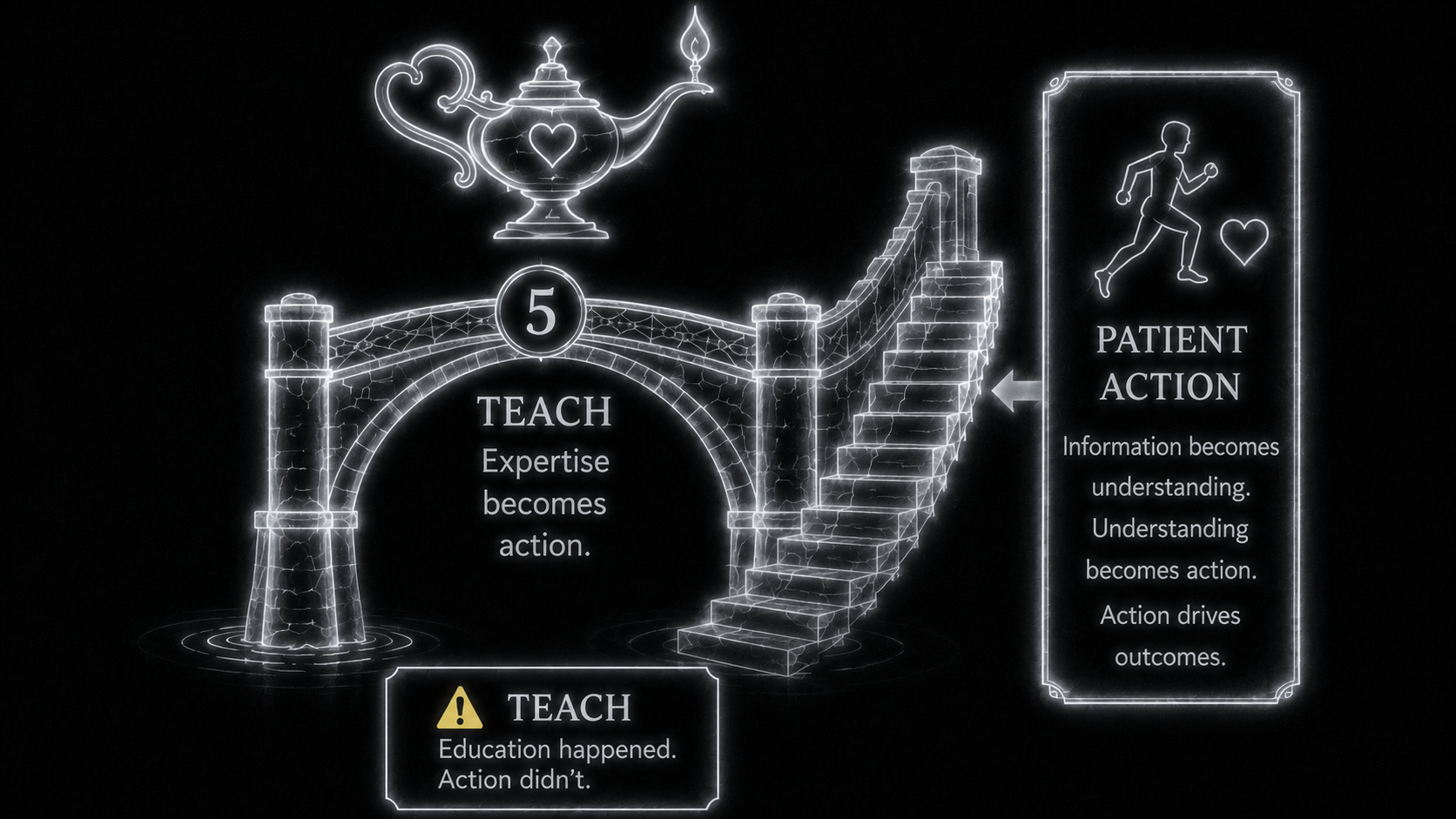
Education doesn't end when the conversation ends. Patients may understand your recommendations yet still struggle to remember, apply, or follow through once they return to everyday life. The Teach stage helps you simplify complex information, build confidence, and turn clinical expertise into meaningful action that lasts beyond the appointment.
When It Goes Wrong:
The patient nods, thanks you, and leaves with the home program. At the next visit, they can't remember the instructions, never started the exercises, or aren't sure they're doing them correctly.
Education happened. Action didn't.
Teach: Expertise Becomes Action
Behavior Change and Patient Compliance.

The more I learn about learning, behavior change, and habit formation, the more I realize we ask patients to make enormous changes.
From our perspective, the recommendation seems simple.
Improve your posture.
Ice three times a day.
Wear your splint.
Don't lift more than five pounds.
Complete your home exercises.
Sleep in a different position.
It's a short list.
But that's because you're reading it while standing in a therapy gym. You're surrounded by exercise equipment. You spend your day helping people move. You've likely developed healthy habits over years of education and clinical practice.
Your patient hasn't. They're trying to fit your recommendations into a life that's already full of work, children, caregiving, bills, stress, pain, and routines they've repeated for decades.
James Clear writes in Atomic Habits that "You do not rise to the level of your goals. You fall to the level of your systems." In other words, behavior isn't determined by good intentions alone. It depends on whether daily routines actually support the new behavior.
Now consider what we're asking. We're not asking someone to remember one new thing. We're asking them to interrupt dozens of automatic behaviors they've repeated thousands of times. If you've ever tried to stop biting your nails, quit checking your phone, change your diet, or start exercising regularly, you already understand this challenge.
Changing a habit isn't simply learning new information. It's replacing an old automatic behavior with a new one.
Learning itself follows a similar pattern. Decades of research demonstrate that people remember information far better when it is reinforced repeatedly over time rather than presented once in a single session. This principle is known as spaced learning or spaced repetition and shows that repetition, distributed across multiple encounters, produces stronger long-term learning and retention than one-time instruction.
Then ask yourself a simple question.
How much reinforcement does your recommendation actually need? One explanation? Three reminders? Six weeks? Three months? A year?
Because if building a new habit requires repeated practice, repeated retrieval, and repeated success...one explanation at the end of a busy appointment probably isn't enough.
And if most healthcare recommendations represent significant behavioral changes...
Post-operative precautions are gargantuan.
For six or eight weeks, we're asking people to consciously override habits they've practiced their entire lives.
Don't push up from the chair.
Don't reach behind your back.
Don't sleep the way you've slept for forty years.
Don't use the hand you've used every day since childhood.
When you see it through that lens, it's remarkable patients succeed as often as they do.
Behavior Change Perspective
People rarely fail because they don't understand what to do.
They fail because new behaviors must compete against established routines, environmental cues, competing priorities, and habits strengthened through years of repetition.
Education changes knowledge. Repetition changes behavior.