
HEArT v ICF
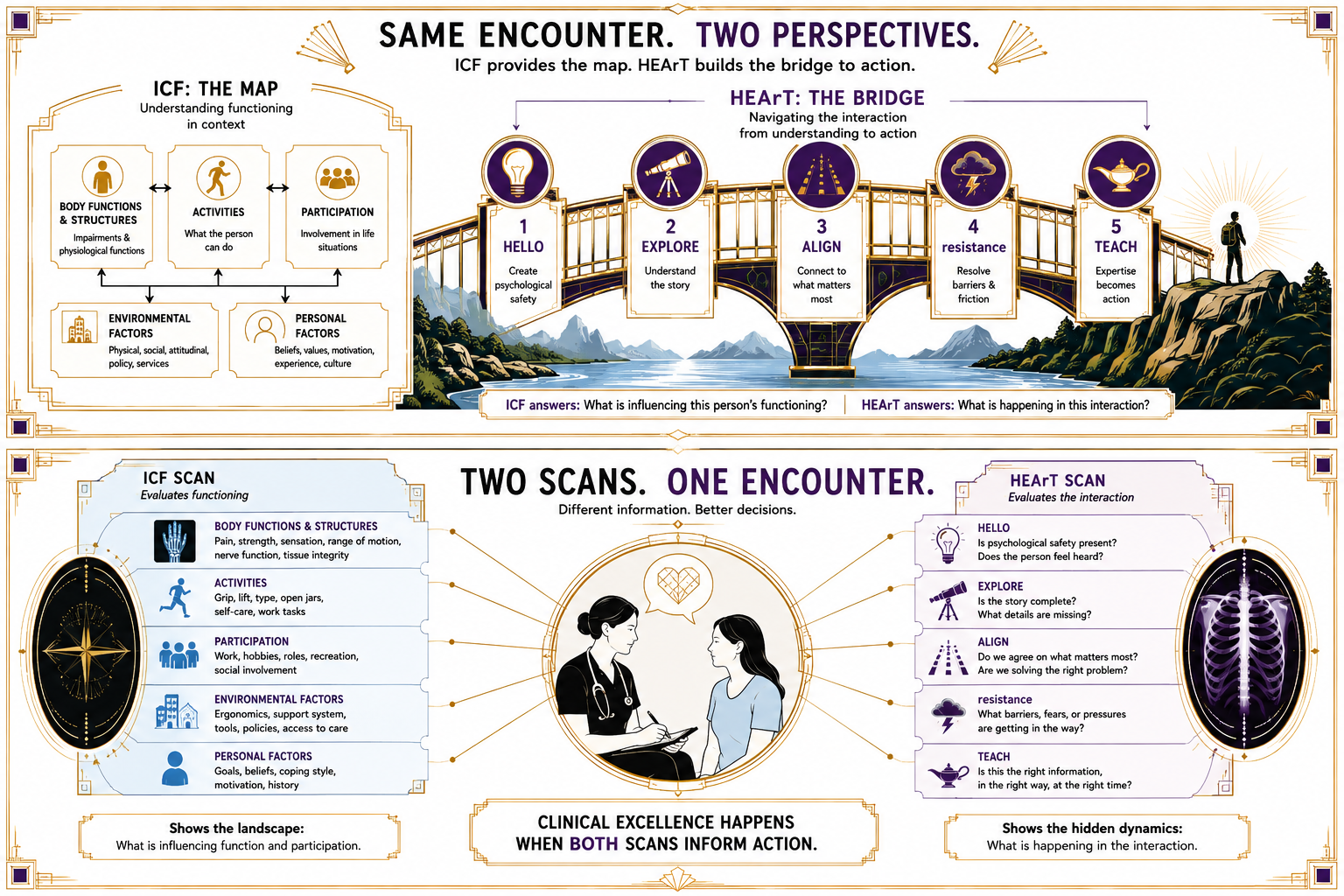
The ICF helps clinicians understand functioning in the context of a person's health condition, environment, and life. But understanding function and identifying a meaningful goal do not necessarily tell us what is happening within the interaction as we try to move toward it. The HEArT Framework adds another lens by helping clinicians evaluate the interaction and locate friction.
ICF helps you understand functioning in context. HEArT helps you evaluate the interaction and locate friction.
The International Classification of Functioning, Disability and Health—the ICF—is the World Health Organization's framework for describing health and disability in the context of a person's actual life.
If you work in rehabilitation, the thinking behind the ICF is probably familiar. It moves us beyond a purely biomedical question—What is wrong with the body?—toward a broader one:
How is this person functioning in the context of their health condition and environment?
The ICF considers body functions and structures, activities, participation, and contextual factors, including environmental and personal factors.
That perspective supports rehabilitation goals that connect clinical findings to activity and participation.
Increasing shoulder flexion to 120 degrees may matter clinically.
Reaching an overhead cabinet to prepare dinner independently tells us why it matters.
That distinction is important. It connects impairment, activity, participation, and context rather than treating them as isolated parts of care.
But knowing what matters does not necessarily tell us what is happening in the interaction as we try to move toward it.
The ICF can help us recognize an activity limitation, participation restriction, or environmental barrier. It can help us think broadly about the personal and contextual factors surrounding a health condition.
The ICF organizes information about functioning and context. It does not organize the clinical interaction itself.
What happens when the functional goal looks excellent on paper, but you aren't sure it reflects the patient's actual priority?
What happens when they understand the home program but don't do it?
What happens when fear may be influencing how they respond to your recommendation?
What happens when the environment, a previous healthcare experience, competing demands at home, or something they haven't told you yet changes what is realistically possible?
These questions sit at the level of the interaction rather than the classification of functioning.
This is where HEArT offers a different lens.
Imagine the goal is:
Patient will be able to pick up their grandchild within eight weeks.
That's a beautiful rehabilitation goal. It connects physical capacity with participation in something personally meaningful.
But writing the goal doesn't create the behavior required to reach it.
The connection between today's seemingly boring exercises and holding that grandchild eight weeks from now has to make sense.
Fear of movement may need to surface. The plan may need to be adjusted if it does not feel realistic or workable.
The plan has to fit into their actual life.
And when progress is slow or stopped, you need a way to evaluate the interaction without deciding too quickly that you already know why.
HEArT does not tell you the hidden explanation. It gives you places to look before deciding what the problem or response should be.
That's where the five HEArT stages become useful.
Hello → Evaluate the conditions.
What did this person experience before you even began?
Explore → Evaluate what you know.
What information is still missing?
Align → Evaluate the priorities.
Are you actually solving the same problem?
resistance → Evaluate the friction.
What is making forward movement difficult?
Teach → Evaluate readiness for action.
Will this plan survive outside the clinic?
Importantly, HEArT does not assume the friction originates with the patient. The clinician, the recommendation, the environment, the timing, the system, or the interaction itself may also be contributing.
There is an especially interesting connection here with the ICF's contextual factors.
Environmental factors are formally classified within the ICF. Personal factors—things such as an individual's background and characteristics—are recognized as important contextual influences but are not classified within the ICF itself because of their substantial social and cultural variation.
HEArT doesn't attempt to classify them either.
Instead, it gives clinicians a repeatable way to notice and evaluate how contextual factors may be shaping the interaction when they become clinically relevant.
The frameworks therefore answer different questions.
ICF asks: What does functioning look like for this person in the context of their health condition and life?
HEArT asks: What is happening in this interaction, and where may friction be affecting movement toward action?
One organizes our understanding of functioning in context.
The other organizes our evaluation of the clinical interaction.
The ICF helps us understand functioning in context. HEArT helps us evaluate the interaction and locate friction.
Under Pressure: Why People Resist — and How to Help Anyway
Share contact information and get notified when course materials are available.
It’s in the works, I promise!