
HEArT vs. Motivational Interviewing
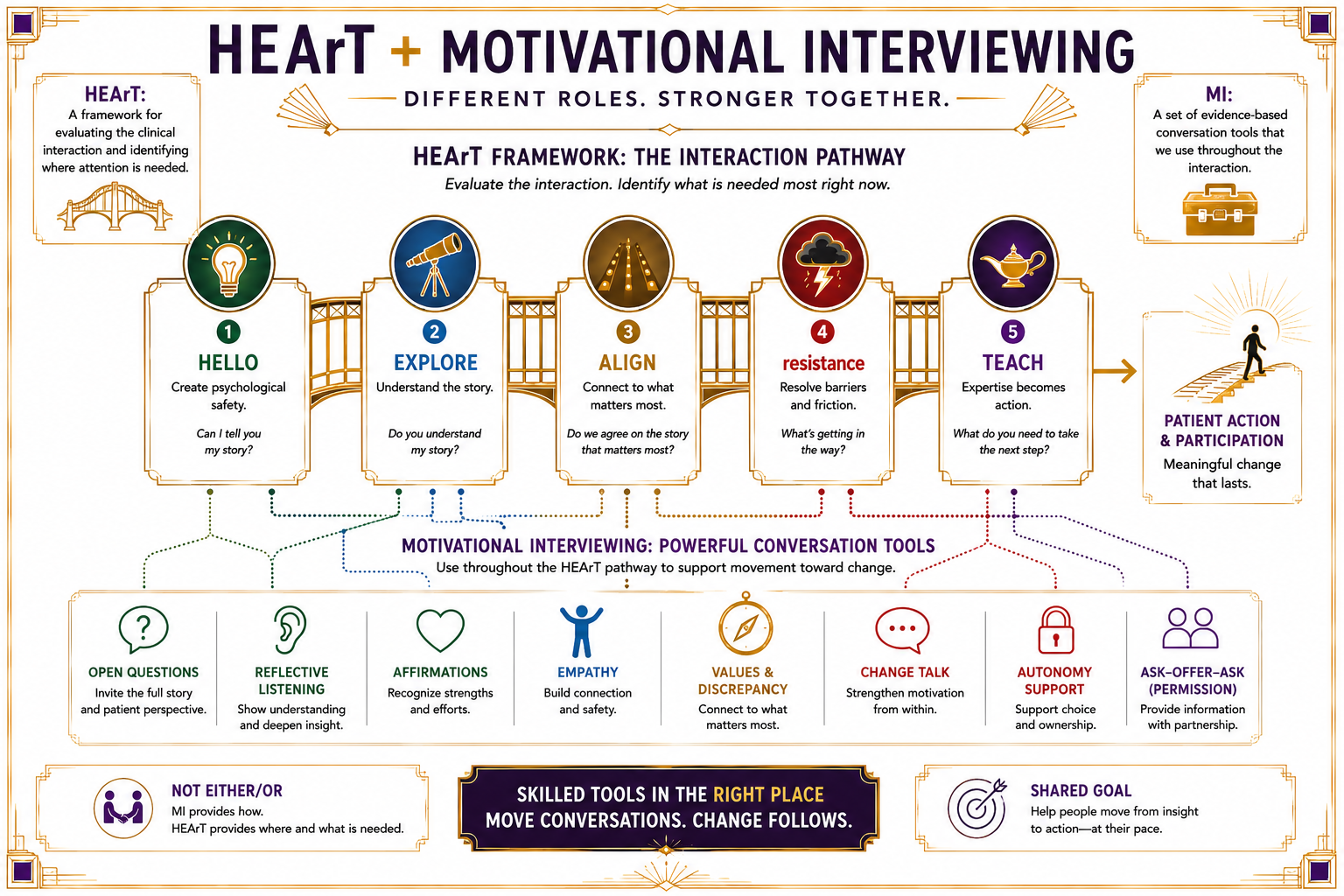
MI helps clinicians facilitate change. HEArT helps clinicians evaluate the interaction and locate friction.
Motivational Interviewing is particularly useful when motivation, commitment, or ambivalence about change is central to the clinical problem. But that is not always where the friction is. A question the patient was afraid to ask, a recommendation aimed at the wrong priority, poor timing, misunderstanding, or an identity threat may be shaping the interaction instead.
HEArT can help clarify what kind of interaction problem may be occurring; MI may be an excellent method when motivation or change is the issue you need to work with.
HEArT vs. Motivational Interviewing — What's the Difference?
If you've done MI training, you'll recognize parts of HEArT immediately—and find that the two organize the clinical problem differently.
When clinicians hear about HEArT for the first time, a common response from anyone who has done communication training is:
"Isn't that just MI?"
It is the right question. It deserves a precise answer.
Motivational Interviewing emerged from William Miller's work with problem drinking in the early 1980s and was subsequently developed with Stephen Rollnick. It emphasizes engagement, focusing, evoking the person's own reasons for change, and planning. Ambivalence is often an important part of that work, but MI is broader than simply resolving ambivalence. MI has a substantial evidence base across behavioral and healthcare settings, although outcomes vary by population, target behavior, and implementation. Its developers have also been careful to define and measure fidelity to the method. There is a reason clinicians are sent to MI training. It earns its reputation.
MI helps with conversations about change.
HEArT helps clinicians evaluate what is happening across the interaction.
This is not a promotion of either one. They are built to answer different clinical questions.
MI can be used in both brief and longer healthcare encounters. Its value is not defined by the length of the conversation, but by the problem it is helping the clinician address: supporting movement toward change through engagement, focusing, evoking, and planning. Developing MI proficiency also involves more than simply knowing a few techniques; fidelity matters.
HEArT starts with a different question: where in this interaction is the friction occurring? The problem may involve motivation or ambivalence. It may also involve the conditions surrounding the interaction, missing information, competing priorities, misunderstanding, identity threat, poor timing, or difficulty turning information into action. HEArT gives the clinician five stages to evaluate rather than assuming the source in advance.
The overlap is real.
The Hello stage overlaps with MI’s emphasis on engagement and the relational conditions that make an effective conversation possible. HEArT extends that lens to what is shaping the interaction before the clinical work really begins—the environment, expectations, first impressions, psychological safety, and any friction the clinician may be inheriting.
The Explore stage of HEArT uses open questions, reflective listening, and the kind of non-judgmental curiosity that MI practitioners will recognize immediately.
The Align stage overlaps with MI's collaborative approach to identifying direction and what matters to the patient.
The resistance stage shares MI's avoidance of argumentation and attention to moments of sustain talk or relational discord. HEArT uses resistance more broadly to examine friction that may arise from the patient, clinician, environment, plan, or interaction itself.
HEArT asks clinicians to apply clinical reasoning to the interaction itself. Its five-stage structure is designed to be usable inside routine clinical encounters, including the compressed, imperfect conversations that happen under everyday healthcare pressure.
If you have done MI training, HEArT will feel like familiar territory in some places and sharply different in others.
The Teach stage illustrates both overlap and difference particularly well. MI includes Planning: moving from motivation and commitment toward a plan for change. HEArT's Teach stage places additional emphasis on what happens to clinical information itself—whether it is understandable, memorable, usable, and able to become action after the patient leaves.
When ambivalence or motivation is central, MI may be exactly what the interaction needs. When the source of friction is unclear, HEArT helps you figure out where to look.
The frameworks can overlap without doing the same job. HEArT does not replace MI. It helps clinicians recognize when MI—or another response—is the right tool for the interaction in front of them.
Under Pressure: Why People Resist — and How to Help Anyway
Share contact information and get notified when course materials are available.
It’s in the works, I promise!