HEArT v Shared Decision-Making
Shared Decision-Making tells us that important healthcare decisions should be made with patients, not for them. But what happens when fear, missing information, competing priorities, or real-life pressure gets in the way? The HEArT Framework helps clinicians evaluate the interaction and locate friction that may be affecting the shared decision—or what happens after it.
Shared Decision-Making structures the decision. HEArT helps evaluate the interaction around it.
Shared Decision-Making (SDM) is one of the most widely adopted approaches in contemporary clinical practice. Its core premise is simple: important healthcare decisions, particularly those involving meaningful trade-offs, should be made with the patient rather than for the patient.
The clinician brings evidence, risk, treatment options, and clinical judgment. The patient brings something equally important: values, preferences, lived experience, priorities, and knowledge of their own life.
Together, they work toward a decision that is both clinically sound and personally meaningful.
There is good reason for the attention SDM has received.Patient decision aids used to support shared decision-making have been shown to improve patient knowledge, risk perception, participation in decisions, and the likelihood that choices reflect patient values. SDM has consequently become an important part of contemporary patient-centered care.
And yet.
Knowing that a decision should be shared does not mean that every part of the interaction is working as intended.
The patient may be frightened.
They may still be trying to figure out what is happening. They may have arrived angry about something that happened before you entered the room.
Perhaps the financial consequences of the plan have not surfaced.
They may agree with the clinical goal but disagree about which problem matters most. Or they may nod through the discussion, say, "That sounds good," and later make a different choice.
This is where HEArT adds something different.
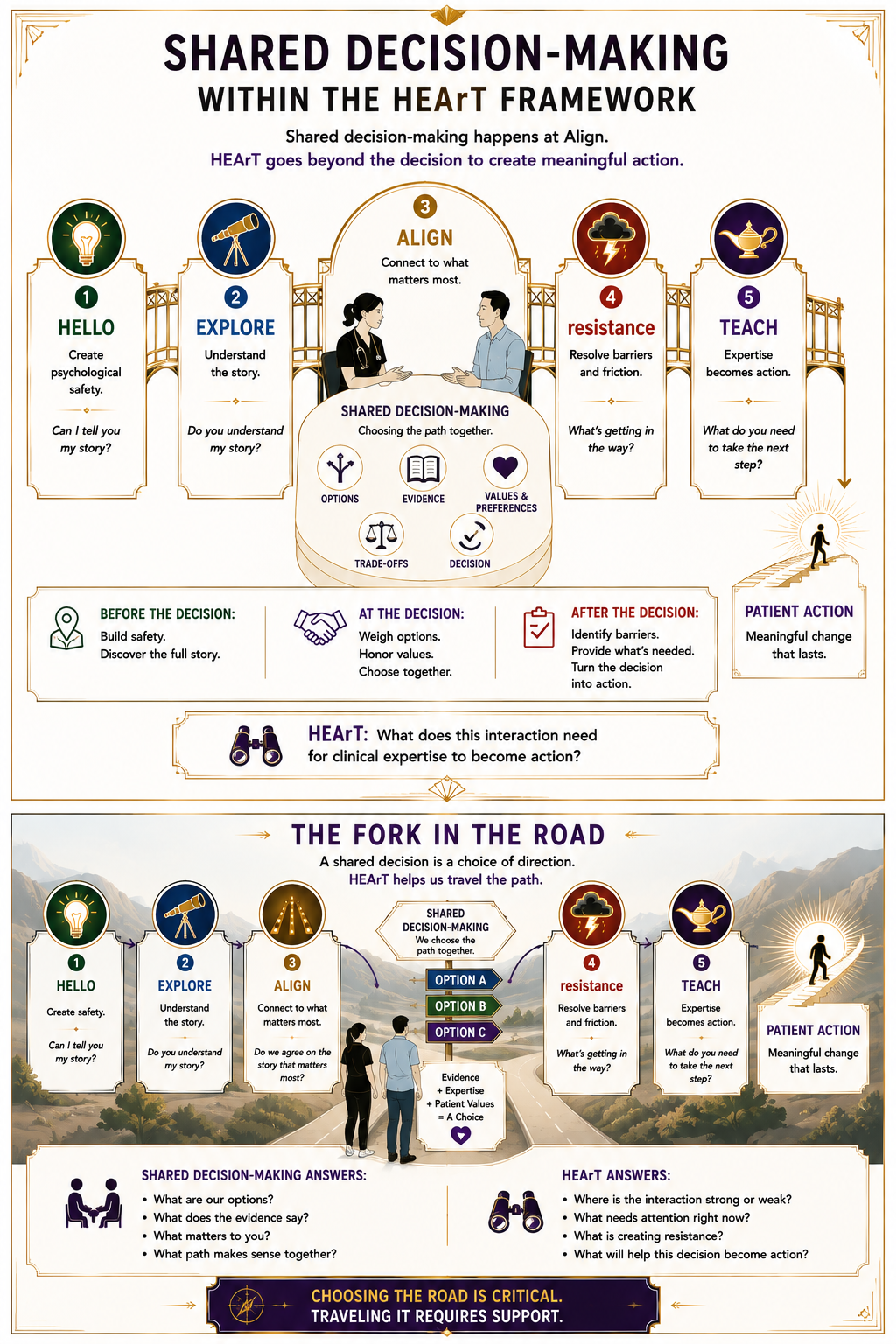
HEArT is not a decision-making framework. It is a framework for evaluating the interaction to identify what may be getting in the way of patient action.
SDM gives us a process for collaborative decision-making. HEArT provides a broader interaction lens that can be used before, during, and after that process to examine where friction may be occurring.
Before assuming we understand what is happening around an important decision, HEArT gives us five places to look.
Hello → Evaluate the conditions.
What did this person experience before we even began?
Explore → Evaluate what you know.
What information is still missing?
Align → Evaluate the priorities.
Are we actually solving the same problem?
resistance → Evaluate the friction.
What is making forward movement difficult?
Teach → Evaluate readiness for action.
Will this plan survive outside the clinic?
That makes HEArT and SDM complementary rather than competing frameworks.
SDM helps structure a decision that should be made together. HEArT helps us recognize when something in the interaction may be preventing that collaboration from working as intended.
Consider the patient who shuts down as you review treatment options.
(Or the patient who nods through the discussion and then makes a different choice afterward.)
The immediate temptation is to explain again. But more information may not be the answer.
Perhaps the story is incomplete.
Perhaps you and the patient are solving different problems.
Perhaps fear, cost, previous healthcare experiences, family demands, or loss of control has introduced pressure.
The patient may understand the recommendation perfectly well and still find that the decision or plan does not fit what is realistically possible in daily life.
Those are not necessarily failures of Shared Decision-Making. They may be signs that something in the interaction remained unresolved.
And there is another distinction worth making: SDM can help clinicians and patients arrive at a shared, values-congruent decision. HEArT also asks what happens when that decision has to become action.
This distinction becomes particularly important under pressure.
Shared Decision-Making necessarily involves cognitive work: understanding options, weighing risks and benefits, considering preferences, and deliberating about trade-offs.
Even a well-supported shared decision places demands on attention, comprehension, deliberation, and emotion. Those demands occur within whatever pressures the patient already brings into the encounter.
Pain competes for attention.
Fear changes what feels important.
Uncertainty increases cognitive demand.
Previous experiences shape expectations.
Financial pressure changes what is realistically possible.
And stress can make an otherwise manageable decision feel enormous.
HEArT asks us to evaluate those pressures as part of the larger interaction, rather than assuming the decision itself is the only place to look.
The question becomes not simply:
"Did we give the patient an opportunity to participate in the decision?"
but also:
"What is happening in this interaction that may be affecting their ability or willingness to participate?"
That is the space HEArT is designed to examine.
SDM structures the shared decision. HEArT helps us evaluate the interaction when something gets in the way.
And when the decision itself goes well but action does not follow, HEArT gives us five stages of the interaction to evaluate to understand where friction may still remain.
Under Pressure: Why People Resist — and How to Help Anyway
Share contact information and get notified when course materials are available.
It’s in the works, I promise!