HEArT v Health Literacy
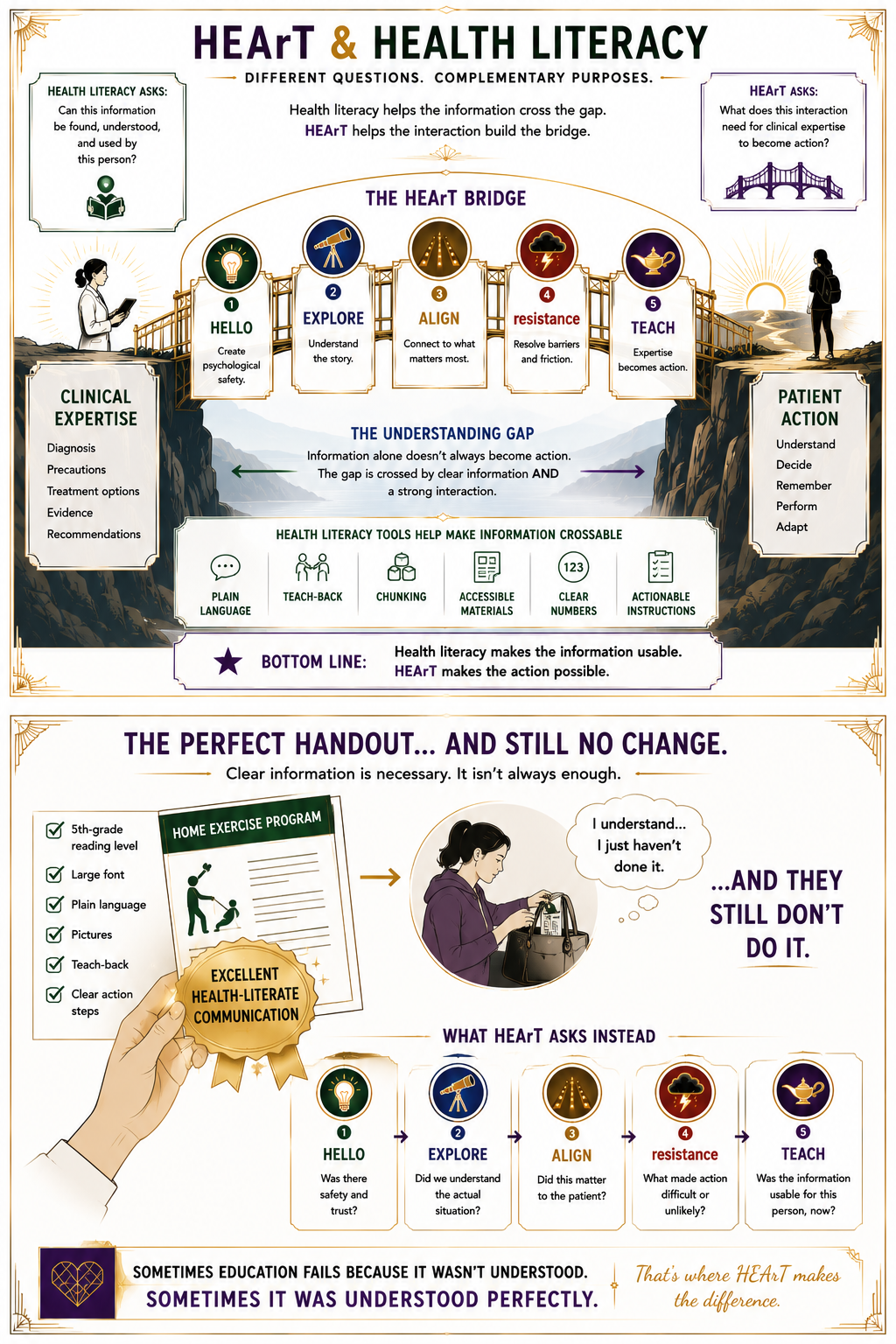
Health literacy strategies help make health information and services easier to find, understand, and use. But when progress stalls, information may not be the only source of friction. The HEArT Framework adds another lens by helping clinicians evaluate the larger interaction and locate where attention may be needed.
Health literacy helps make information and services findable, understandable, and usable. HEArT helps evaluate the interaction and locate friction.
Health literacy strategies shape how people find, understand, and use health information and services.
Think about what we routinely ask patients to do:
Understand discharge instructions in the hours after surgery.
Remember medication schedules while managing acute pain.
Learn new precautions and apply them.
Interpret risk and make decisions based on it.
Compare treatment options.
Then take all of that information home and somehow translate it into action.
Healthcare has developed excellent tools to make this easier. Plain-language principles reduce unnecessary complexity and jargon. Teach-Back checks whether information was actually understood rather than simply delivered. Ask Me 3 encourages patients to leave knowing three essential things: What is my main problem? What do I need to do? Why is it important for me to do this?
These tools matter.
Plain language is not dumbing information down. It is making important information usable. And Teach-Back addresses one of healthcare's most persistent assumptions: just because we explained something does not mean the patient understood it.
But even successful understanding introduces another question: Was information actually the source of friction?
A patient can accurately Teach-Back your instructions and still not carry them out later.
Fear may be relevant. Competing demands may matter. Another priority may not have surfaced. The recommendation may not feel realistic. Stress may make information harder to retain, organize, or use.
Any of those explanations are possible.
That's where HEArT adds another layer.
Health literacy strategies help us ask how health information and services can be made easier to find, understand, and use.
HEArT asks:
What is happening in this interaction—and is information actually where the friction lies?
That distinction matters because Teach is the last stage of HEArT, not the first.
Before Teach comes Hello. Evaluate the conditions.
What did this person experience before you even began?
Then Explore. Evaluate what you know.
What information is still missing?
Then Align. Evaluate the priorities.
Are you actually solving the same problem?
Then resistance. Evaluate the friction.
What is making forward movement difficult?
And then Teach. Evaluate readiness for action.
Will this plan survive outside the clinic?
HEArT does not assume that stalled progress means the patient misunderstood, lacked motivation, or was not ready. The source of friction may be the information, the recommendation, the timing, the clinician's assumption, the environment, the system, or some combination of these.
The overlap with health literacy strategies is especially visible in Teach.
Use plain language. Reduce unnecessary complexity. Check understanding. Use Teach-Back. Provide accessible written information. Reinforce the important pieces over time.
But successful understanding does not, by itself, explain what happens next.
A patient can understand every word you said and still not act on the plan for reasons that are not yet clear.
Under Pressure: Why People Resist — and How to Help Anyway
Share contact information and get notified when course materials are available.
It’s in the works, I promise!