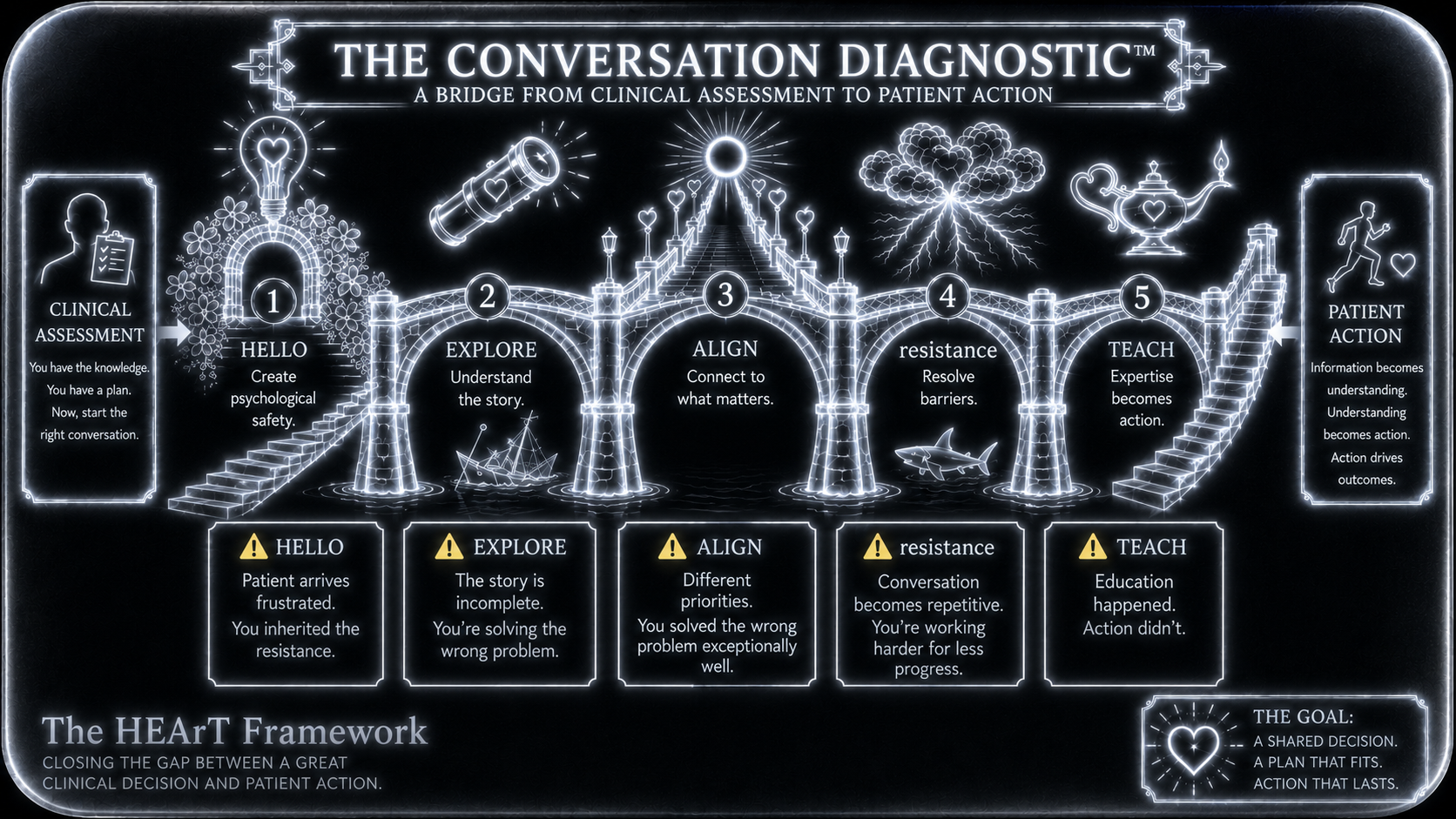
Resistance: Recognize Friction Before You Repeat Yourself
The harder you push, the harder people often push back. Resistance isn't something to overcome—it's something to understand. The resistance stage teaches you how to recognize communication friction, diagnose what's creating it, and transform difficult conversations into opportunities for collaboration.
When It Goes Wrong:
The complaints become repetitive. The patient's world becomes smaller. Every conversation circles back to the same frustration, and new ideas seem impossible to consider.
You find yourself working harder while making less progress.
Not all resistance looks like resistance.
Not all resistance looks like resistance.
When most people imagine a difficult patient, they picture someone who is angry.
Someone arguing. Refusing treatment. Someone raising their voice.
Those conversations certainly exist. But they aren't the only form of resistance.
Sometimes resistance smiles. Then it nods. It says, "Okay." or “You’re right.”
Then never does the home exercise program, never wears the splint, never makes a change.
Resistance exists on a spectrum.
On one end is the pleasant patient who agrees with everything you recommend but never follows through.
On the other is the patient who is openly frustrated, refuses treatment, or becomes verbally aggressive.
Most of us recognize the second. The first is much easier to miss.
The HEArT Framework defines resistance differently. Resistance isn't simply disagreement. It's friction. It's anything that prevents clinical expertise from becoming meaningful patient action. That friction can come from a hundred different pressures the patient carries into the room.
The clinician is working under pressure, too.
You're managing productivity, documentation, scheduling, prior authorizations, changing regulations or insurance requirements, interruptions.
The expectation to solve complex problems in very little time.
When two people are both working under pressure, friction is inevitable. The goal isn't to eliminate resistance. The goal is to recognize it before you keep pushing in the same direction.
One of the earliest signs of resistance isn't anger. It's repetition.
The conversation starts going in circles. Progress is frozen.
When that happens, the problem usually isn't that the patient needs more information.
It's that something is creating friction.
The longer I practice, the more interested I become in asking,
"What pressure is making this path forward so hard?"