
The HEArT Framework
A bridge from clinical assessment to patient action.
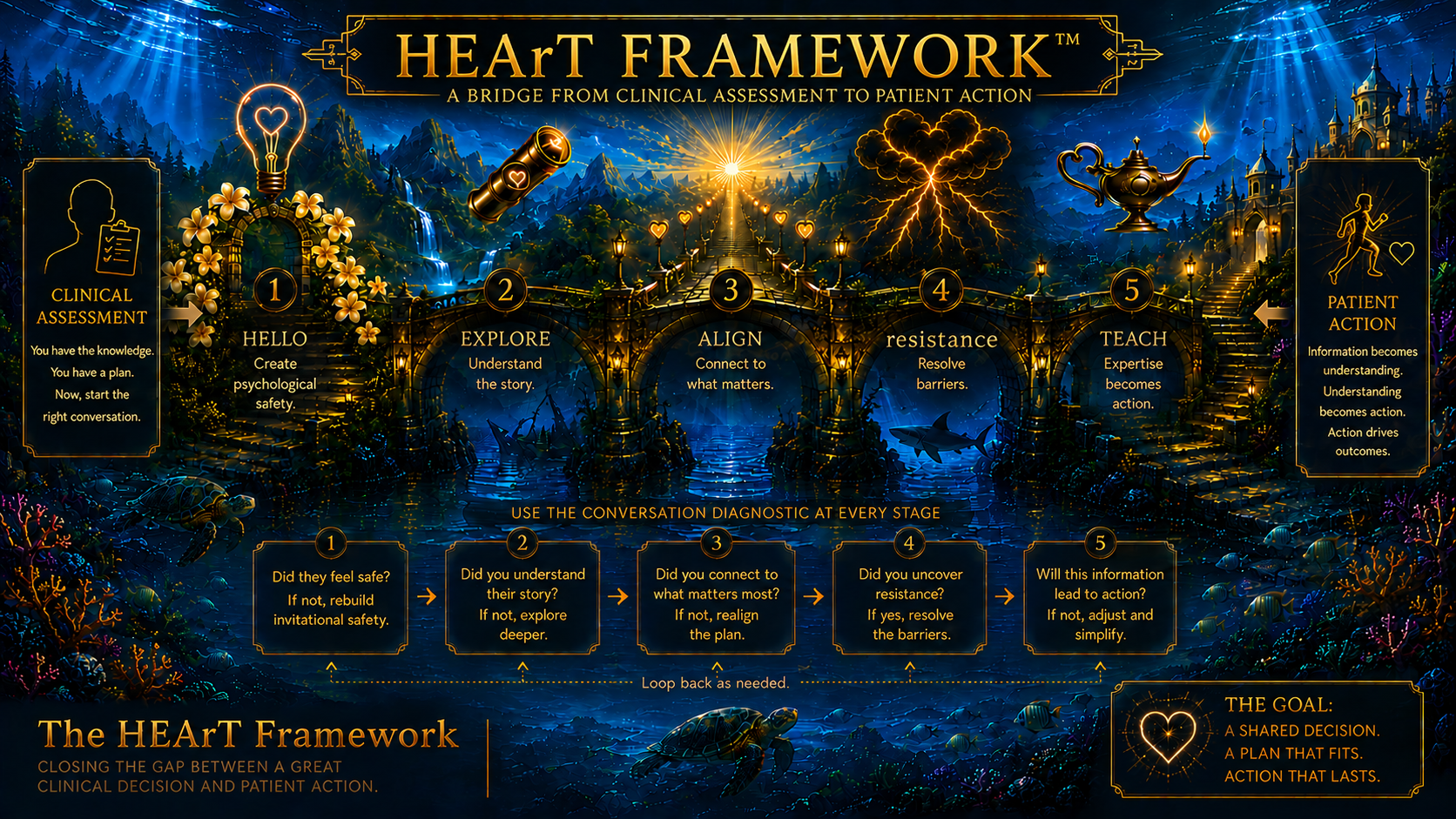
Healthcare has no shortage of approaches to communication and behavior change.
Structured interviews. Behavioral interventions. Shared decision-making. Motivational interviewing. Teach-back. Decision aids. Reflective listening. Patient activation tools.
Every discipline has its own canon, its own preferred language, and its own training modules.
And most experienced clinicians have encountered more than a few frameworks they were taught, appreciated, and then had to fit into an already crowded clinical toolbox.
So what problem would justify adding another framework?
Where does this actually fit?
HEArT is not a replacement for your clinical training. It isn't another communication protocol to follow in sequence from a laminated card. It isn't a therapy model, a behavioral intervention, or a script for telling you what to say next.
HEArT helps clinicians evaluate the interaction and locate friction, especially when good clinical decisions aren't becoming patient action.
Clinical training prepares us remarkably well to evaluate the patient, identify problems, establish goals, select interventions, and make recommendations.
But then something has to happen.
Across the interaction, the patient has to be able to share what is actually going on. We have to identify what matters. Information has to be understood. Recommendations have to make sense within the patient's life. And at some point, clinical expertise has to become something the patient can use.
What happens in the space after the clinical decision is right—but before the patient can actually use it?
The space between clinical expertise and patient action is where HEArT operates.
After all, if the problem isn’t obvious, where do you look?
Hello, Explore, Align, resistance, and Teach are not five steps for talking to people. They are five stages to look when progress isn't happening the way you expected.
Hello → Evaluate the conditions.
What did this person experience before you even began?
Explore → Evaluate what you know.
What information is still missing?
Align → Evaluate the priorities.
Are you actually solving the same problem?
resistance → Evaluate the friction.
What is making forward movement difficult?
Teach → Evaluate readiness for action.
Will this plan survive outside the clinic?
This also helps explain where HEArT sits alongside other established approaches.
Shared Decision-Making structures collaborative decisions. HEArT helps clinicians evaluate the interaction and locate friction around that process.
Health literacy strategies help make health information and services findable, understandable, and usable. HEArT asks where information fits within the larger interaction—and whether information is actually the problem.
Motivational Interviewing helps with conversations about change. When motivation, commitment, or ambivalence is central, MI may be exactly what the interaction needs. HEArT helps clinicians evaluate the larger interaction and locate friction.
The ICF organizes understanding of health and functioning in context. HEArT organizes evaluation of the clinical interaction.
These frameworks aren't in competition.
They answer different questions.
Sometimes we’re using the right technique in the wrong place.
We may be explaining beautifully when the real problem is alignment.
We could be trying to help someone through ambivalence when we're still missing half the story.
We might be simplifying education when understanding was never the part of the interaction that needed more attention.
Or we may be working harder and harder to move the interaction forward without first examining where the friction is coming from.
How do you know which skill the interaction actually needs?
HEArT helps you locate the friction before deciding what tool to reach for.
HEArT is designed to remain usable when time is short and the interaction is imperfect.
You can use it when you have three minutes.
You can use it with someone you've known for years or someone you met thirty seconds ago.
What if you realize halfway through the explanation that teaching was never the problem?
You can start at Hello during a first encounter—or realize halfway through Teach that the problem is actually sitting back in Align.
HEArT is not strictly linear because clinical interactions aren't strictly linear.
It gives you a structured way to evaluate what is happening, identify what may be getting in the way, and decide where your attention belongs next.
That's where HEArT fits.
Not as a replacement for Shared Decision-Making, Motivational Interviewing, health literacy, clinical reasoning, or the frameworks you already use.
HEArT is a complementary framework for the space between clinical expertise and meaningful patient action.
Check out each stage:
-
![Create Psychological Safety]()
Hello: Create Psychological Safety
-
![Understand the Story]()
Explore: Understand the Story
-
![Connect to What Matters]()
Align: Shared Decision-Making and Patient Buy-In
-
![Resolve Barriers]()
resistance: Patient Resistance and Difficult Healthcare Conversations
-
![Expertise Becomes Action]()
Teach: Patient Education and Teach-Back





Under Pressure: Why People Resist — and How to Help Anyway
Share contact information and get notified when course materials are available.
It’s in the works, I promise!