
The Framework You Already Use — You Just Don't Have a Name for It
Experienced clinicians often know when something is off before they can explain exactly why. They notice missing information, misaligned priorities, hidden friction, and whether a patient is ready to act. HEArT gives those familiar clinical instincts a structure—making them easier to evaluate deliberately, apply under pressure, and teach to others.
There is something worth saying to the experienced clinician approaching HEArT with a little skepticism:
Some of this may feel familiar.
If you have been practicing for years, you have probably developed clinical instincts that extend far beyond the biomedical problem in front of you.
You notice when a patient is holding something back.
You can feel when the goal you just proposed didn't stick with the other person.
You slow down with certain patients—not because a protocol tells you to, but because something about the interaction tells you that moving faster will get you nowhere.
Maybe you ask the question that isn't on the intake form because the answers you already have don't quite explain what you're seeing.
You abandon the education you planned because you realize the patient isn't ready for it yet.
Those instincts matter.
And many of them are reflected in HEArT.
You are noticing the conditions surrounding the interaction.
You are recognizing when you don't have the whole story.
You are sensing when your priorities and the patient's priorities aren't quite aligned.
You are responding to friction before it becomes obvious resistance.
And you are adjusting what you teach based on the patient's readiness for action.
Skilled clinicians have been doing versions of these things for a very long time.
HEArT didn't invent clinical intuition. It gives some of that intuition a structure.
Expertise often becomes automatic. After thousands of patient encounters, an experienced clinician may recognize that something is off without consciously identifying what they noticed or why they changed course.
That's useful when you are the clinician.
It's much harder when you have to teach someone else how to do it.
"Read the room."
"Build rapport."
"Meet them where they are."
"Use your clinical judgment."
These instructions make perfect sense to someone who has spent fifteen years developing that judgment. They are considerably less useful to someone in year two who is still trying to figure out what, exactly, they are supposed to be noticing.
HEArT makes the invisible work easier to see.
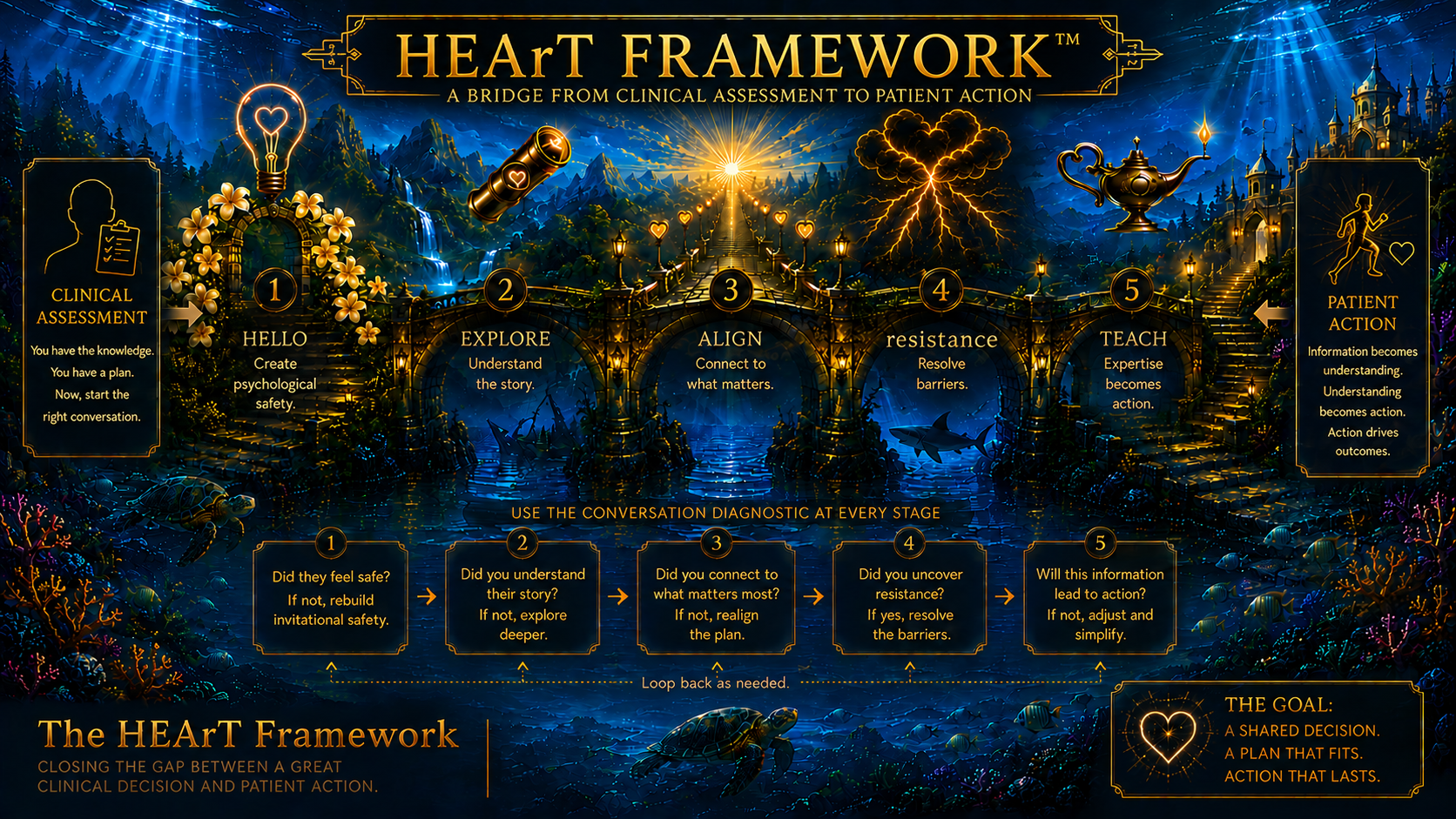
Hello → Evaluate the conditions.
What did this person experience before you even began?
Explore → Evaluate what you know.
What information is still missing?
Align → Evaluate the priorities.
Are you actually solving the same problem?
resistance → Evaluate the friction.
What is making forward movement difficult?
Teach → Evaluate readiness for action.
Will this plan survive outside the clinic?
Giving these patterns names does something else for the experienced clinician, too.
It makes intuition easier to use deliberately.
Under pressure, even excellent clinicians compress their process. You move faster. You make assumptions. You explain earlier. You rely on patterns that usually work.
Sometimes that's exactly what efficiency requires.
Sometimes it's where momentum gets lost.
A framework gives you a way to look back and ask something more useful than:
"Why didn't that patient follow through?"
You can ask:
Were the conditions working against us?
What didn't I know?
Were we actually aligned on goals?
Where was the friction?
Was this plan ready to become action?
Now the interaction becomes something you can examine rather than simply experience.
And that has implications beyond your own practice.
You can use the same structure to supervise a student, debrief a difficult encounter, or discuss a case with a colleague.
Recognize why an approach that worked beautifully with one patient … failed completely with another.
Or help a newer clinician develop judgment without simply telling them to wait ten years for experience to provide it.
The individual skills within HEArT are not revolutionary. Nor should they be.
What matters is putting them into a structure that clinicians can recognize, evaluate, apply, and teach.
So if you encounter HEArT and think:
"I already do some of this."
Good.
The more interesting question is:
Can you identify when you're doing it, why it's working, and what to evaluate when it stops working?
That's the value of the framework.
HEArT takes patterns experienced clinicians may recognize intuitively and makes them visible enough to evaluate, deliberate enough to apply, and structured enough to teach.

The Hardest Interaction to Fix May Be the One That Seemed to Go Well
Some of the most important clinical breakdowns are easy to miss. The patient nods, agrees with the plan, and leaves without any obvious resistance—then nothing changes. HEArT gives clinicians five places to look when an interaction seems to go well but never becomes meaningful patient action.
The patient who yells is easy to identify.
The family member who storms out gets everyone's attention. The encounter that ends in a complaint, a canceled procedure, or a formal grievance leaves little doubt that something went wrong.
Visible friction is hard to miss.
But some of the most consequential breakdowns in healthcare are much quieter.
They're the interactions that seemed fine.
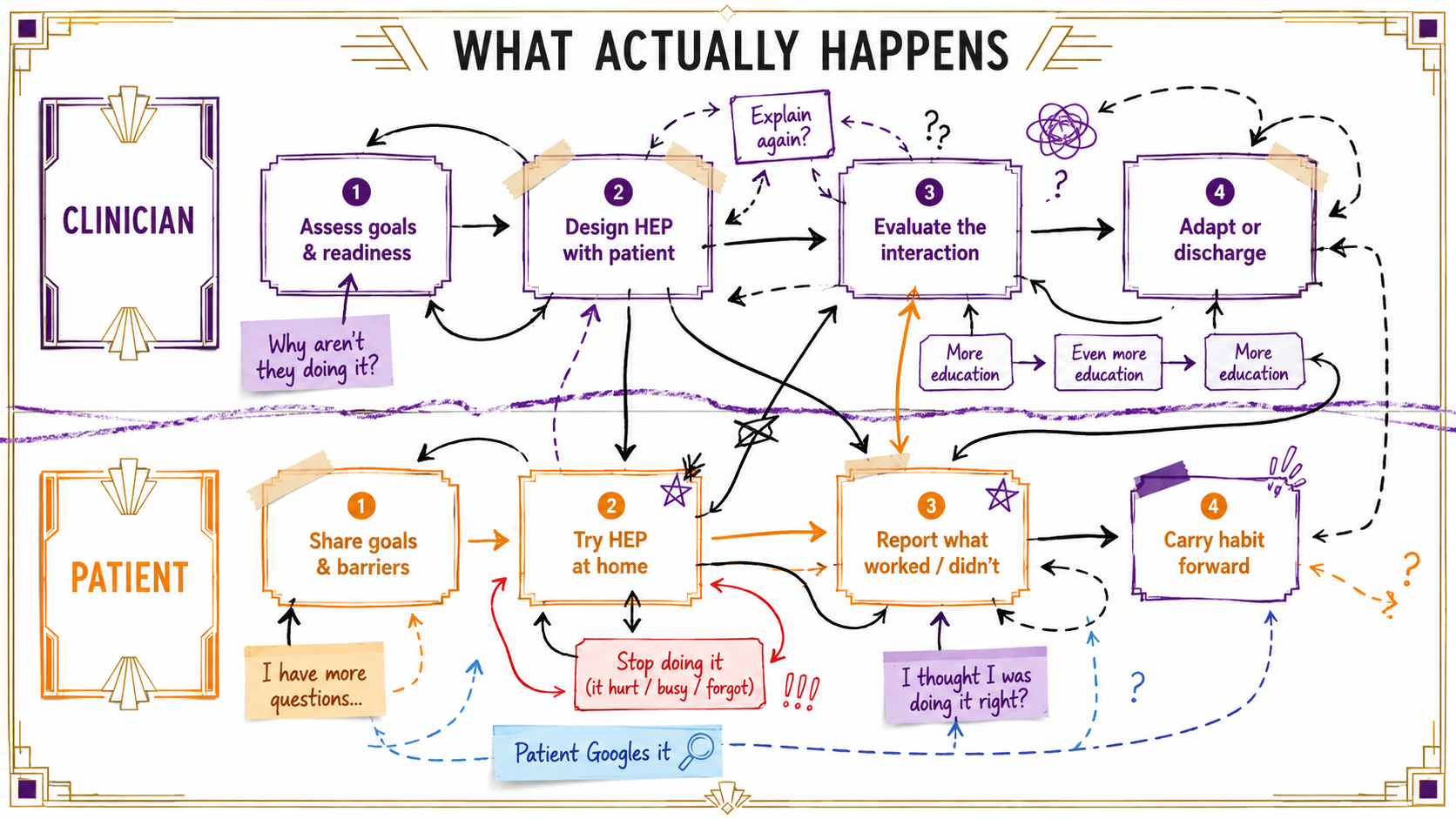
The patient nods through the entire home program explanation and does none of it.
They agree to the referral and never make the appointment.
They say, "That makes sense. I'll try it," and return six weeks later with the same problem, slightly worse and perhaps a little more discouraged.
Or they never push back at all.
No argument. No difficult questions. No obvious resistance.
They simply stop engaging.
By the usual signals, the interaction may have looked successful. The clinician was respectful. The information was accurate. The recommendation was evidence-informed. The patient appeared to understand.
And nothing changed.
This is the problem HEArT is designed to help us examine: the gap between an interaction that appears to go well and one that actually leads to patient action.
Healthcare has developed valuable approaches for conflict, de-escalation, difficult news, shared decisions, motivation, and patient education. Those tools matter.
But there is another problem that is remarkably easy to miss:
What do you do when nothing obviously went wrong?
When the patient isn't angry. They don't disagree. They don't tell you the plan won't work.
When the interaction ends pleasantly—and the recommendation quietly disappears once real life resumes.
The temptation is to interpret agreement as evidence that everything worked.
But a nod can mean many things:
I understand.
I don't understand, but I don't want to ask again.
I understand, but I disagree.
I agree, but I can't do this.
I don't want to disappoint you.
I just want to go home.
That's why HEArT isn't primarily a framework for managing difficult people or difficult conversations.
It gives clinicians five places to look when good clinical decisions aren't becoming patient action.
Hello → Evaluate the conditions.
What did this person experience before you even began?
Perhaps the interaction never had the conditions for openness in the first place.
Explore → Evaluate what you know.
What information is still missing?
Perhaps the patient answered every question you asked, but the information that would change your understanding never surfaced.
Align → Evaluate the priorities.
Are you actually solving the same problem?
Perhaps the patient agreed to your goal because it was easier than explaining that something else mattered more.
resistance → Evaluate the friction.
What is making forward movement difficult?
Resistance doesn't always look like an argument. Sometimes it looks remarkably cooperative.
Teach → Evaluate readiness for action.
Will this plan survive outside the clinic?
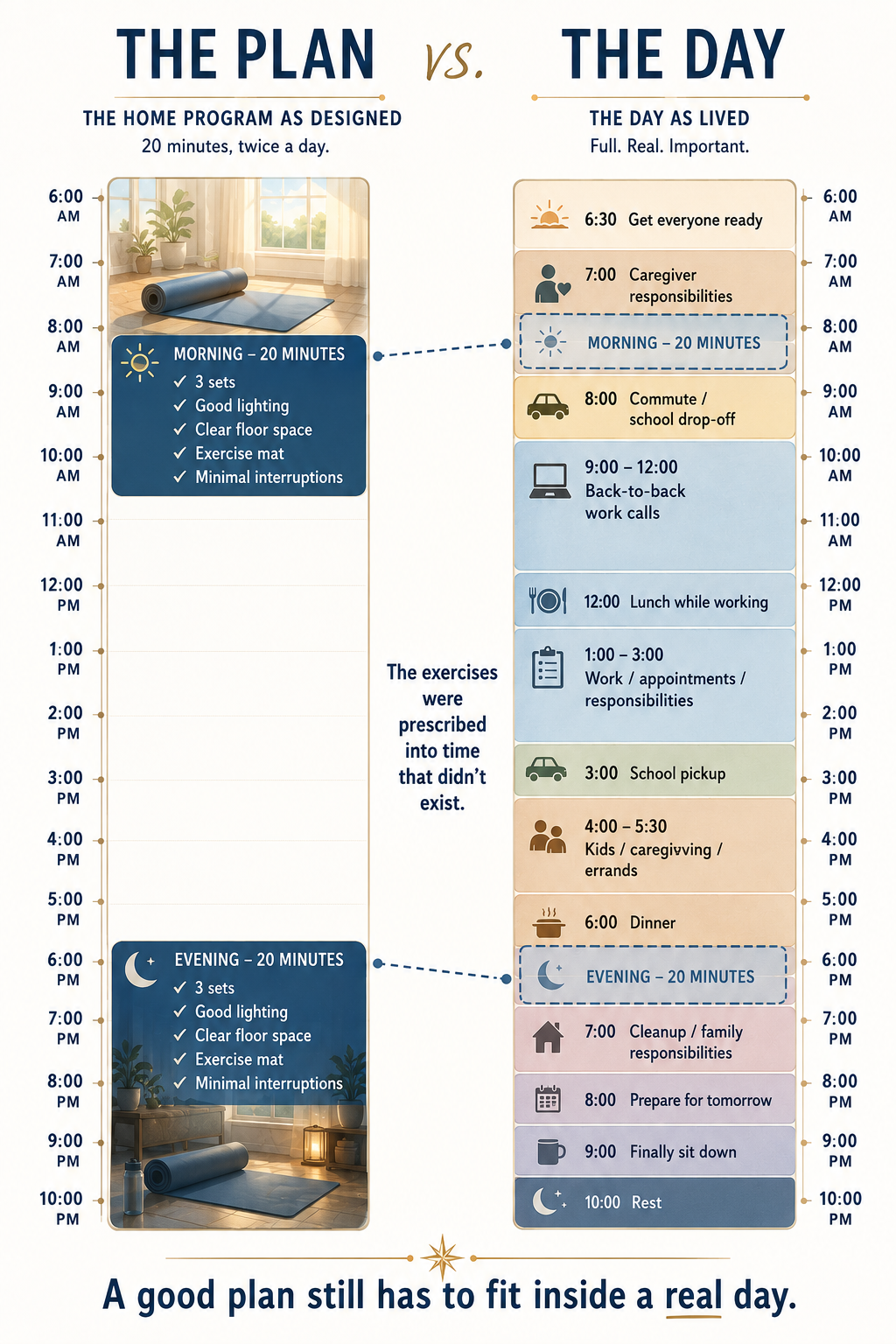
The patient may understand the recommendation perfectly well. The real problem may begin the moment they return to work, childcare, fatigue, fear, finances, habits, or a schedule with no obvious place for your plan.
None of those problems requires a dramatic encounter.
That's precisely why they're easy to miss.
HEArT gives us a way to look again—not simply at what was said, but at the larger interaction surrounding what happened next.
Because the question isn't only:
"Did the appointment go well?"
It's:
"What happened after it did?"
A pleasant interaction is not the same thing as an effective one. Understanding is not the same thing as alignment. Agreement is not the same thing as readiness. And the absence of visible resistance does not mean there was no friction.
Sometimes the interaction that deserves a closer look is the one everyone thought went perfectly well.
HEArT gives you a map for the friction you can see—and the friction you can't.
HEArT v ICF
The ICF helps clinicians understand how health conditions affect function, activity, and participation in a person's life. But identifying a meaningful goal doesn't guarantee movement toward it. The HEArT Framework adds another lens, helping clinicians evaluate the conditions, missing information, priorities, friction, and readiness that may influence patient action.
ICF helps you understand functioning in context. HEArT helps you understand what may be getting in the way of action.
The International Classification of Functioning, Disability and Health—the ICF—is the World Health Organization's framework for describing health and disability in the context of a person's actual life.
If you trained in physical therapy, occupational therapy, or rehabilitation medicine in the last twenty years, the thinking behind the ICF is probably familiar. It helped move rehabilitation beyond a purely biomedical question—What is wrong with the body?—toward a much broader one:
What can this person do, in this environment, and how is their health affecting participation in life?
The ICF considers body functions and structures, activities, participation, and contextual factors, including environmental and personal factors. That perspective changed how rehabilitation professionals think about goals.
Increasing shoulder flexion to 120 degrees may matter clinically.
Reaching an overhead cabinet to prepare dinner independently tells us why it matters.
That distinction is important. It connects impairment to function, function to participation, and treatment to a person's actual life.
But knowing what matters does not necessarily tell us what is getting in the way of getting there.
The ICF can help us recognize an activity limitation, participation restriction, or environmental barrier. It can help us think broadly about the personal and contextual factors surrounding a health condition.
It was not designed, however, to give clinicians a step-by-step process for evaluating what is happening within an interaction when the patient isn't moving toward the plan.
What happens when the functional goal looks excellent on paper, but the patient doesn't actually care about it?
What happens when they understand the home program but don't do it?
What happens when fear changes how they interpret your recommendation?
What happens when the environment, a previous healthcare experience, competing demands at home, or something they haven't told you yet changes what is realistically possible?
This isn't a shortcoming of the ICF. The ICF was never designed to solve that problem.
This is where HEArT offers a different lens.
Imagine the goal is:
Patient will be able to pick up their grandchild within eight weeks.
That's a beautiful rehabilitation goal. It connects physical capacity with participation in something personally meaningful.
But writing the goal doesn't create the behavior required to reach it.
The patient still has to understand how today's seemingly boring exercises connect to holding that grandchild eight weeks from now.
They have to believe the plan is realistic. They have to tell you if they're afraid to move.
The plan has to fit into their actual life.
And when something interferes with progress, you need a way to determine what is getting in the way.
That's where the five HEArT stages become useful.
Hello → Evaluate the conditions.
What has this person experienced before you even begin?
Explore → Evaluate what you know.
What information is still missing?
Align → Evaluate the priorities.
Are you actually working toward the same goal?
resistance → Evaluate the friction.
What is making forward movement difficult?
Teach → Evaluate readiness for action.
Will this plan survive outside the clinic?
There is an especially interesting connection here with the ICF's contextual factors.
Environmental factors are formally classified within the ICF. Personal factors—things such as an individual's background and characteristics—are recognized as important contextual influences but are not classified within the ICF itself because of their substantial social and cultural variation.
HEArT doesn't attempt to classify them either.
Instead, it gives clinicians a repeatable way to notice, explore, and respond to the individual and contextual factors that emerge during care.
The frameworks therefore answer different questions.
ICF asks: How is this health condition affecting this person's functioning and participation in life?
HEArT asks: What is happening in this interaction that may be helping—or getting in the way of—movement toward action?
One helps us understand the person in context.
The other helps us evaluate what is happening as we try to move forward together.
The ICF helps define what meaningful function looks like. HEArT helps us evaluate what it may take to get there.

HEArT vs. Motivational Interviewing
When clinicians hear about HEArT for the first time, the most common response from anyone who has done communication training is: "Isn't that just MI?"
It is the right question. It deserves a precise answer.
Motivational Interviewing is one of the most rigorously studied behavioral interventions in existence. It was built for sustained, session-length engagement with ambivalence - the internal conflict a person feels when part of them wants to change and part of them doesn't. When it works, it works because the patient talks themselves into change. There is a reason clinicians are sent to MI training. It earns its reputation.
Here is the distinction that matters: MI is a therapeutic model. HEArT is an interaction diagnostic.
MI is designed for the patient sitting across from you, genuinely conflicted about whether to change. HEArT is designed for figuring out whether that is actually the problem you are dealing with - in a fourteen-minute appointment, a hallway conversation, a follow-up call that has already run long. The obstacle might be ambivalence. Or it might be a question the patient was too afraid to ask, a recommendation that solved the wrong problem, or a moment of identity threat that shut the room down before instruction began. HEArT helps you determine which one you're facing before you try to fix it.
When clinicians hear about HEArT for the first time, the most common response from anyone who has done communication training is: "Isn't that just MI?"
It is the right question. It deserves a precise answer.
Motivational Interviewing was developed in the early 1980s by clinical psychologists William Miller and Stephen Rollnick, initially for use in addiction counseling. Its core mechanism is exploring and resolving ambivalence — the internal conflict a person feels when part of them wants to change and part of them doesn't. MI is built around a therapeutic stance: the clinician operates as a guide who reflects the patient's own words back to them, elicits change talk, and avoids argumentation. It is patient-paced, often open-ended, and explicitly non-directive. When it works, it works because the patient talks themselves into change.
MI is one of the most rigorously studied behavioral interventions in existence. It has strong evidence across addiction, diabetes management, smoking cessation, medication adherence, and physical activity. Its developers were careful to train practitioners over many hours and to measure fidelity to the model. There is a reason clinicians are sent to MI training. It earns its reputation.
So here is the distinction: MI is a therapeutic model. HEArT is an interaction diagnostic.
This is not a promotion of either one. They are built for different moments.
MI is designed for sustained, session-length engagement with ambivalence. It assumes the clinician has time to sit with the patient's internal conflict, to reflect and summarize and wait. It assumes the primary obstacle to change is the patient's own ambivalence. And it requires significant training to implement with fidelity — the evidence is clear that untrained or partially trained MI is much less effective than the real thing.
HEArT is designed for the clinical encounter as it actually exists: a fourteen-minute appointment, a hallway conversation, a follow-up call, a home visit that has already run long. It does not assume the obstacle is ambivalence. It assumes the obstacle might be unmet expectations, identity threat, poor timing, a question the patient was too afraid to ask, or a recommendation that solved the wrong problem. HEArT helps you figure out which one you're dealing with before you try to fix it.
The overlap is real. The Explore stage of HEArT uses open questions, reflective listening, and the kind of non-judgmental curiosity that MI practitioners will recognize immediately. The Align stage shares MI's commitment to meeting the patient where they are rather than where you want them to be. The resistance stage draws on MI's foundational insight that arguing with resistance tends to harden it.
But HEArT does not ask you to become a counsellor. It asks you apply clinical reasoning to your interaction. It gives you a five-stage map that works in three minutes or thirty. And it does not require formal training to implement — it requires awareness.
If you have done MI training, HEArT will feel like familiar territory in some places and sharply different in others. The Teach stage, in particular, has no real MI equivalent. MI does not address what happens after the patient is ready to act. HEArT is built specifically for that moment — and for everything that blocks it.
Think of it this way: MI is the right tool for the patient who is sitting across from you, genuinely conflicted about whether to change.
HEArT is the right tool for bridging clinical assessment into patient action.
HEArT v Shared Decision-Making
Shared Decision-Making tells us that important healthcare decisions should be made with patients, not for them. But what happens when fear, missing information, competing priorities, or real-life pressure gets in the way? The HEArT Framework helps clinicians evaluate the interaction and identify what may be preventing shared decisions from becoming meaningful patient action.
Shared Decision-Making tells you what to decide together. HEArT helps create the conditions to get there.
Shared Decision-Making (SDM) is one of the most widely adopted approaches in contemporary clinical practice. Its core premise is simple: important healthcare decisions, particularly those involving meaningful trade-offs, should be made with the patient rather than for the patient.
The clinician brings evidence, risk, treatment options, and clinical judgment. The patient brings something equally important: values, preferences, lived experience, priorities, and knowledge of their own life.
Together, they work toward a decision that is both clinically sound and personally meaningful.
There is good reason for the attention SDM has received. Research has associated shared decision-making and the use of patient decision aids with greater patient knowledge, more accurate perceptions of risk, greater participation in decisions, and decisions that better reflect patient values. SDM has consequently become an important part of contemporary patient-centered care.
And yet.
Knowing that a decision should be shared does not mean the conditions for sharing it are already in place.
The patient may be frightened.
They may still be trying to figure out what is happening. They may have arrived angry about something that happened before you entered the room.
Or, may be listening politely while privately thinking about whether they can afford to miss work.
They may agree with the clinical goal but disagree about which problem matters most. Or they may nod through the entire discussion, say, "That sounds good," and go home with absolutely no intention of doing it.
This is where HEArT adds something different.
HEArT is not a decision-making framework. It is a framework for evaluating the interaction to identify what may be getting in the way of patient action.
Before asking a patient to participate in an important decision, HEArT gives us five places to look.
Hello → Evaluate the conditions.
What did this person experience before we even began?
Explore → Evaluate what you know.
What information is still missing?
Align → Evaluate the priorities.
Are we actually solving the same problem?
resistance → Evaluate the friction.
What is making forward movement difficult?
Teach → Evaluate readiness for action.
Will this plan survive outside the clinic?
That makes HEArT and SDM complementary rather than competing frameworks.
SDM helps structure a decision that should be made together. HEArT helps us recognize when something in the interaction may be preventing that collaboration from working as intended.
Consider the patient who shuts down as you review treatment options.
(Or the patient who nods through the discussion and then does the opposite.)
The immediate temptation is to explain again. But more information may not be the answer.
Perhaps the story is incomplete.
Perhaps you and the patient are solving different problems.
Perhaps fear, cost, previous healthcare experiences, family demands, or loss of control has introduced pressure.
Many times, the patient understands the recommendation perfectly well, but the plan simply cannot survive their actual life.
Those are not necessarily failures of Shared Decision-Making. They may be signs that the conditions required for meaningful participation were never fully established.
This distinction becomes particularly important under pressure.
Shared Decision-Making necessarily involves cognitive work: understanding options, weighing risks and benefits, considering preferences, and deliberating about trade-offs. But patients do not arrive as neutral decision-making machines. They arrive as people.
Pain competes for attention.
Fear changes what feels important.
Uncertainty increases cognitive demand.
Previous experiences shape expectations.
Financial pressure changes what is realistically possible.
And stress can make an otherwise manageable decision feel enormous.
HEArT asks us to take those conditions seriously rather than moving directly to the decision itself.
The question becomes not simply:
"Did we give the patient an opportunity to participate in the decision?"
but also:
"What is happening in this interaction that may be affecting their ability or willingness to participate?"
That is the space HEArT is designed to examine.
SDM tells us that the decision belongs to both of us.
HEArT helps us evaluate what needs to happen for us to actually get there.
HEArT v Health Literacy
Health literacy tools help make healthcare information understandable. But a patient can understand every word and still not act. The HEArT Framework adds another layer by helping clinicians evaluate the conditions, priorities, friction, and readiness that influence what happens after the information is delivered.
Health literacy tools help make information understandable. HEArT asks whether the patient is ready to use it.
Health literacy is one of the most important—and easily underestimated—factors in patient care.
Think about what we routinely ask patients to do:
Understand discharge instructions in the hours after surgery.
Remember medication schedules while managing acute pain.
Learn new precautions and apply them.
Interpret risk and make decisions based on it.
Compare treatment options.
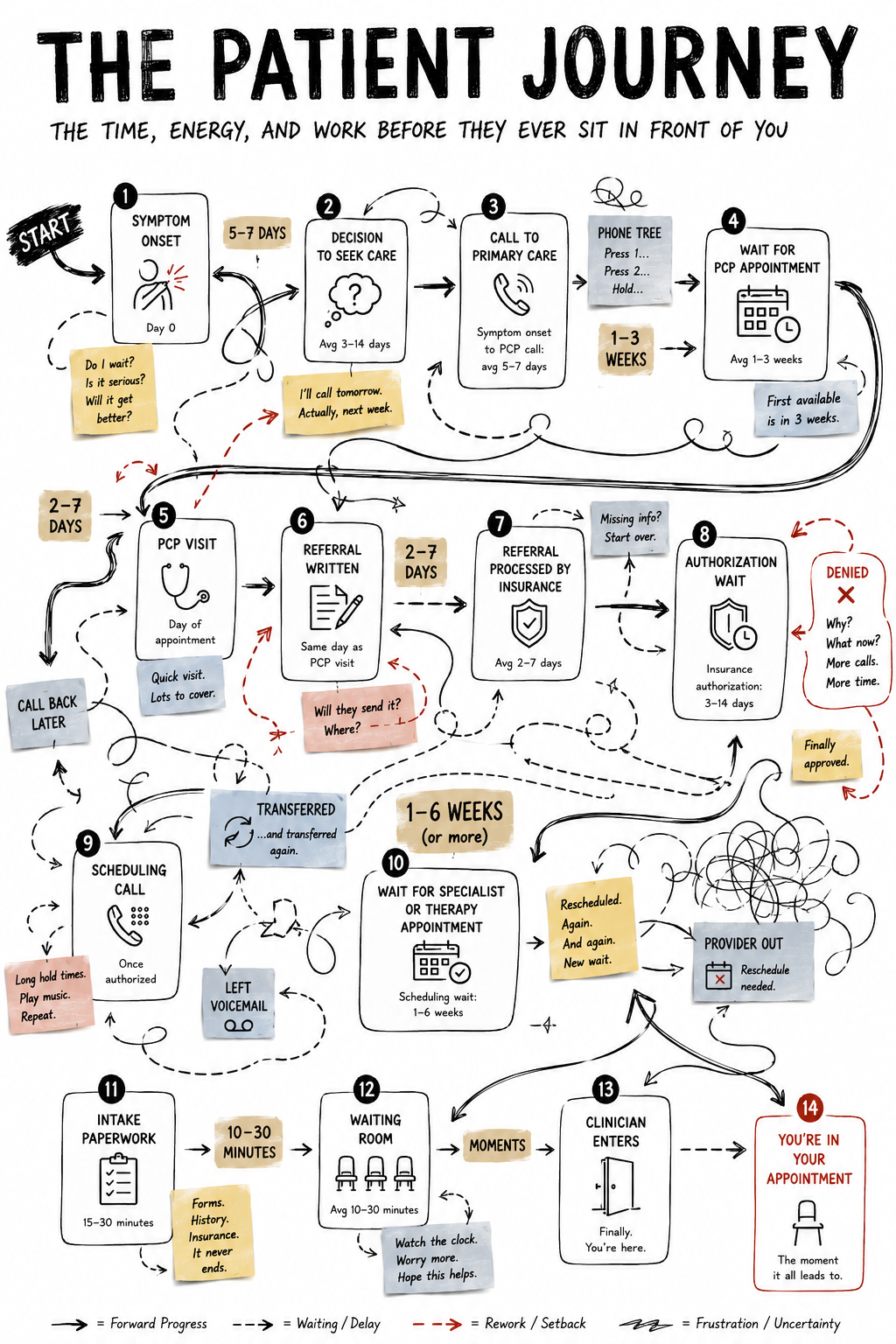
Then take all of that information home and somehow translate it into action.
Healthcare has developed excellent tools to make this easier. Plain-language principles reduce unnecessary complexity and jargon. Teach-Back checks whether information was actually understood rather than simply delivered. Ask Me 3 encourages patients to leave knowing three essential things: What is my main problem? What do I need to do? Why is it important for me to do this?
These tools matter.
Plain language is not dumbing information down. It is making important information usable. And Teach-Back addresses one of healthcare's most persistent assumptions: just because we explained something does not mean the patient understood it.
But understanding introduces another question.: Was information the thing getting in the way?
A patient can accurately Teach-Back your instructions and still … never follow them.
They may understand exactly what you want them to do and be frightened to do it.
They may understand the home program but have nowhere in their day to put it.
Or understand the treatment options but be hyper focused on a concern no one has addressed.
They may know exactly why the recommendation matters—and quietly disagree that it matters enough.
Or they may be so overwhelmed by everything that has happened that even beautifully designed information has nowhere to stick in their brain.
That's where HEArT adds another layer.
Health literacy helps us ask: How can I make this information easier to understand and use?
HEArT asks:
What is happening in this interaction that may affect what happens next?
That distinction matters because Teach is the last stage of HEArT, not the first.
Before Teach comes Hello. Evaluate the conditions.
What has this person experienced before the information is delivered?
Then Explore. Evaluate what you know.
What information is still missing?
Then Align. Evaluate the priorities.
Are you and the patient solving the same problem?
Then resistance. Evaluate the friction.
What is making forward movement difficult?
And then Teach. Evaluate readiness for action.
Will this plan survive outside the clinic?
This last stage is where health literacy strategies become especially valuable. Use plain language. Reduce unnecessary complexity. Check understanding. Use Teach-Back. Provide accessible written information. Reinforce the important pieces over time.
But don't mistake successful information transfer for successful behavior change.
A patient can understand every word you said and still not be able, ready, or willing to act on it.
Health literacy helps make information usable. HEArT helps us evaluate the interaction around it—and what may still be standing between understanding and action.

Where the HEArT Framework Fits in Healthcare Communication
Healthcare has no shortage of communication frameworks. So where does HEArT fit? Rather than replacing the tools clinicians already use, HEArT helps evaluate the interaction when good clinical decisions aren't leading to action—identifying whether the problem lies in the conditions, missing information, priorities, friction, or readiness for action.
Healthcare has no shortage of communication frameworks.
Structured interviews. Behavioral interventions. Shared decision-making. Motivational interviewing. Teach-back. Decision aids. Reflective listening. Patient activation tools.
Every discipline has its own canon, its own preferred language, and its own training modules. And every clinician who has been practicing for more than five years probably has a growing collection of frameworks they were taught, appreciated—and promptly put in a binder.
So the first honest question about HEArT should be:
Where does this actually fit?
HEArT is not a replacement for your clinical training. It isn't another communication protocol to follow in sequence from a laminated card. It isn't a therapy model, a behavioral intervention, or a script for telling you what to say next.
HEArT is a framework for evaluating the interaction when good clinical decisions aren't leading to action.
Clinical training prepares us remarkably well to evaluate the patient, identify problems, establish goals, select interventions, and make recommendations.
But then something has to happen.
The patient has to tell us what's actually going on and we have to identify what matters. Information has to be understood.
Whatever the recommendation is, has to make sense within the patient's life.
And eventually, the patient has to leave and do something.
The space between clinical expertise and patient action is where HEArT operates.
Hello, Explore, Align, resistance, and Teach are not five steps for talking to people. They are five places to look when progress isn't happening the way you expected.
Hello → Evaluate the conditions.
What did this person experience before you even began?
Explore → Evaluate what you know.
What information is still missing?
Align → Evaluate the priorities.
Are you actually solving the same problem?
resistance → Evaluate the friction.
What is making forward movement difficult?
Teach → Evaluate readiness for action.
Will this plan survive outside the clinic?
This also helps explain where HEArT sits alongside other established approaches.
Shared Decision-Making helps clinicians and patients make important decisions together. HEArT can help identify whether the conditions for meaningful participation are actually present.
Health literacy strategies help make information understandable and usable. HEArT asks whether information is actually what the patient needs right now—and what else may be standing between understanding and action.
Motivational Interviewing offers a sophisticated method for exploring ambivalence and strengthening motivation for change. HEArT overlaps with many of its principles, particularly around autonomy and resistance, but applies a broader lens to the entire clinical interaction.
The ICF helps rehabilitation professionals understand functioning and participation in context. HEArT asks what may be helping or getting in the way as the patient moves toward meaningful action.
These frameworks aren't in competition.
They answer different questions.
Sometimes we’re using the right technique in the wrong place.
We may be explaining beautifully when the real problem is alignment.
We may be trying to help someone through ambivalence when you're still missing half the story.
We may be simplifying education when the patient understood you perfectly well—they just don't believe the plan will work.
Or we may be working harder and harder to overcome resistance without asking what the resistance is telling us.
HEArT helps you locate the friction before deciding what tool to reach for.
That also means HEArT doesn't require a perfect 45-minute encounter.
You can use it when you have three minutes.
You can use it with someone you've known for years or someone you met thirty seconds ago.
You can start at Hello during a first encounter—or realize halfway through Teach that the problem is actually sitting back in Align.
HEArT is not strictly linear because clinical interactions aren't strictly linear.
It gives you a repeatable way to evaluate what is happening, identify what may be getting in the way, and decide where your attention belongs next.
That's where HEArT fits.
Not as a replacement for Shared Decision-Making, Motivational Interviewing, health literacy, clinical reasoning, or the frameworks you already use.
HEArT is a complementary layer for the space between knowing what to recommend and helping that recommendation become meaningful patient action.